The Daily Forest Report October 10, 2013 Die Sonne
by nielskunze on October 10, 2013
Strange things can happen when the fog lifts.
It was all about the sky… starting with the honking of invisible geese to draw my attention upward. There was a line in the sky stretching east-west. It looked like the contrail from an airplane… except it was way too low. (If I stood on my tippy-toes and really stretched, I could almost touch it.) The line in the sky was traveling with me, moving slowly from north to south. The rest of the clouds, just a teensy bit higher, were traveling the opposite direction, south to north. It was kinda weird, but I didn’t know what to make of it.
I don’t recall what specifically brought the sun into my attention, but it really grabbed hold. The Sun wished to speak. Huh! Imagine that!
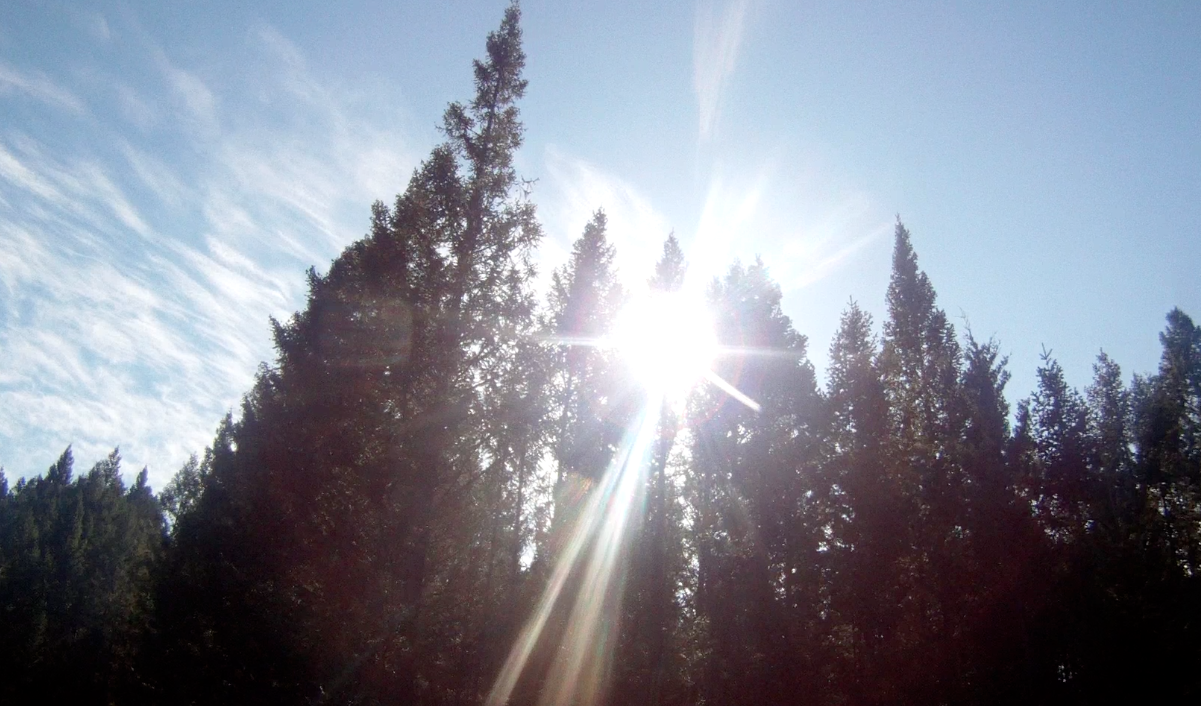
Now, the Sun and I have not dialogued much. Our communication was spotty at best, so the best I can do is just give a bit of a summary of our interaction.
The first thing to note is that German was the first language I spoke. I was fluent in German by age three, and became fluent in English at age four. (English is now my primary language.) How is this relevant, you ask? There’s a bit of a mystery that’s been bugging me for years… and it’s rooted in German. In western society, we universally accept the Sun to be a masculine “personality.” However, in German, “the Sun” is referred to as “die Sonne.” The thing is… “die” is the feminine determiner in German, not the masculine. What’s up with that?
The pre-christian gnostics always maintained that the Sun is indeed a feminine entity. She chose early on to ally herself with Sophia (Earth) when things began to first get dicey. If we look back to most ancient languages, Sanskrit for instance, we find that the Sun retains a feminine determiner. Only in later linguistic developments is the Sun subsequently designated to be masculine. Interesting, no?
Furthermore, and this is just an aside, if we consult the ancient languages and mythology, we find that the Moon was accepted as being masculine. The Sun resembles the ovum in relative size and colour (when reddish), and the Moon represents the sperm– small and white. Additionally, the Sun is perceived with centrality and reliable constancy– like a mother, whereas the Moon is quite variable and even completely disappears (new moon) at times– like a father. Kinda shakes things up a bit, eh?
So I was asking the “Hugging Tree” whether the Sun was primarily masculine or feminine or possibly neutral, when the word “delight” was suddenly inserted into my consciousness. It was actually the Sun throwing that word at me. Again, very interesting. If one didn’t know the word “delight,” it is quite likely that the definition arrived at would be exactly opposite to its meaning. Being “de-lighted” would naturally suggest being thrown into darkness. What a strange word! (And one that I will be careful in using in the future!)
When we choose to connect with “sky energy” it can be very chaotic, confusing and likely rather ineffectual if we’re trying to connect with the “masculine” energy of the Sun or the “feminine” energy of the Moon. Have we been misled?
And there’s just one more little thing. If both the Earth and the Sun are feminine personalities, and only the Moon is masculine, then it would seem the “heavens” are somewhat unbalanced… in favour of the feminine. But there is very credible evidence presently emerging which suggests that our Sun has a companion star. It is a brown dwarf star, so nearly undetectable optically, but the gravitational effects are imminently observable. It takes nearly 26,000 years for our two suns to orbit one another… which provides the most credible explanation yet for the “wobble” in the Earth’s axis which causes the precession of the equinoxes– or the changing of the great ages. Is the brown dwarf companion masculine? Most likely.
Basically, the Sun was telling me “Before we proceed into the New Age, let’s just get a few things straight.” Well, there you go.
Leave your comment